Executive Summary
- Who this is for: Enterprise Architects, Solution Architects, Senior Engineers, Architecture Leads
- Problem it solves: Architects solve problems from scratch that other industries solved decades ago — paying a reinvention tax that accumulates silently across every design cycle
- Key outcome: A structured method to identify, evaluate, and transfer proven patterns from outside the technology industry into architecture practice
- Time to implement: 30–60 days to build a Cross-Domain Pattern Library and embed it into architecture review
- Business impact: Faster pattern selection, reduced design risk, more resilient systems, and architecture decisions grounded in decades of proven practice — not first principles
The Submarine Engineer and the Software Architect
In the 1900s, naval engineers faced a terrifying problem.
A ship could flood.
Not all at once — but in sections.
A torpedo strike, a hull breach, a failure nobody predicted.
The water would spread.
And the ship would sink.
Their solution was deceptively simple.
Divide the hull into sealed compartments.
A breach floods one section.
The walls hold.
The rest of the ship survives.
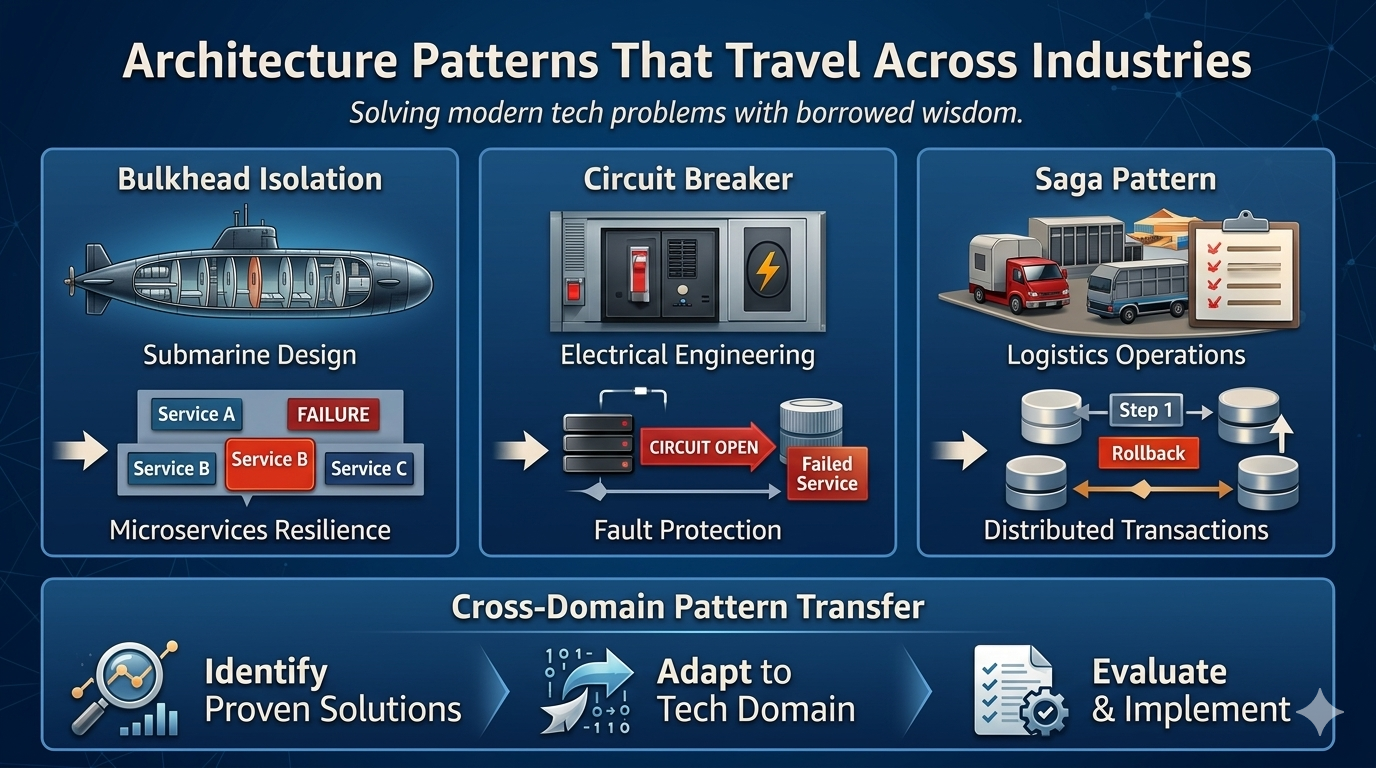
They called it bulkhead isolation.
It became standard in every ship built since.
Now consider the software architect, one hundred years later.
Designing a microservices platform.
One service is taking on too much load.
Failures are cascading.
One overwhelmed thread pool is dragging the entire system down.
They call a design review.
They whiteboard for three days.
They coin a pattern.
They publish an RFC.
They name it bulkhead isolation.
It is the same idea.
Built on the same logic.
Arrived at independently.
At a cost that the naval engineer already paid in 1912.
The Pattern Reinvention Tax
Every organization pays it.
Not as a line item on a budget.
As design cycles spent solving problems that are already solved.
As architecture reviews that debate solutions with known answers.
As production incidents caused by patterns that other industries have understood for decades.
The reinvention tax is invisible.
It accumulates quietly in every sprint.
It grows whenever an architect stays inside the boundaries of their industry's pattern vocabulary.
What Domain Silos Do to Pattern Libraries
Most architects develop their pattern vocabulary from one source.
Their industry.
A fintech architect learns from fintech postmortems.
A healthcare architect learns from healthcare case studies.
A logistics architect learns from logistics failures.
Each domain builds its own pattern language.
And each domain solves the same underlying problems — concurrency, failure isolation, state management, consistency under load — independently.
As if the others do not exist.
This is not ignorance.
It is proximity bias.
The postmortems that matter are the ones from your industry.
The conferences that matter are the ones your peers attend.
The patterns that matter are the ones your colleagues recognize.
And so a pattern that solved the problem in 1962 — in a completely different domain — goes unexamined.
Until someone reinvents it.
Patterns That Already Made the Journey
The most durable architecture patterns in software did not originate in software.
They traveled.
In electrical engineering, a circuit breaker has one job.
When current exceeds safe limits, it opens.
It disconnects the failing component.
It protects the rest of the circuit from cascading damage.
It does not try to diagnose the fault.
It does not wait to see if the situation improves.
It opens. It protects. It waits for reset.
In software, the Circuit Breaker pattern does the same thing.
A downstream service becomes unresponsive.
The breaker opens.
Requests stop flowing into the failing path.
The rest of the system is protected.
After a threshold interval, the breaker tests for recovery.
The pattern is identical.
The domain is completely different.
Electrical engineers solved this in the 1920s.
Software architects documented it in the 2000s.
Eighty years of reinvention tax.
The Dead Letter Queue
Every postal system has one.
A letter arrives with an incomplete address.
The postal system cannot deliver it.
It does not discard the letter.
It routes it to a holding facility.
Someone examines it.
Determines whether it can be readdressed, returned, or disposed of.
The decision is deliberate.
Not automatic.
In distributed messaging, a dead letter queue works identically.
A message cannot be processed.
It does not vanish.
It does not cause the consumer to fail permanently.
It routes to a separate holding queue.
A deliberate process handles it.
The postal system was doing this in the nineteenth century.
Asynchronous messaging architectures adopted it formally in the 1990s.
The Saga Pattern
A long-distance freight transaction involves dozens of parties.
A shipper. A carrier. A customs authority. A port operator. A destination warehouse.
Each step is discrete.
Each can fail independently.
And when one fails, the system does not halt.
It compensates.
It triggers a reversal of prior steps.
It records what happened.
It returns to a consistent state.
Logistics and trade finance have handled this pattern for centuries.
Distributed systems architects named it the Saga pattern in 1987.
The concept is unchanged.
Only the domain is different.
The Cross-Domain Pattern Transfer Model
Recognizing that patterns travel is not enough.
Architecture practice needs a method to find them, evaluate them, and bring them home.
Cross-Domain Pattern Transfer (CDPT)
Cross-Domain Pattern Transfer is the discipline of systematically identifying architecture patterns proven in non-technology domains and evaluating their applicability to current design problems.
It is not analogy hunting.
It is not metaphor making.
It is a structured practice that asks a precise question before every design decision.
Has this problem been solved — at scale, under real failure conditions — in a domain I am not currently looking at?
The Cross-Domain Pattern Transfer Model
CDPT operates across three layers.
Layer 1: Problem Shape Identification
Before searching for a pattern, name the problem in domain-agnostic terms.
Not "our microservices are cascading failures."
But "a local failure in one component is propagating state corruption across connected components."
Not "our message queue is losing events."
But "a transaction cannot be completed and the record of the failed attempt is being discarded."
When the problem is expressed in structural terms, the domain boundary disappears.
The same problem shape exists in electrical systems, postal networks, hospital triage, and aviation incident management.
The structural description is what allows the cross-domain search to begin.
| Domain-Specific Statement | Domain-Agnostic Problem Shape |
|---|---|
| Our service is getting overwhelmed and failing others | Unconstrained resource consumption in one node degrading connected nodes |
| Messages are being lost when consumers fail | State records of incomplete transactions are not persisted |
| One bad release takes down the whole platform | A local fault propagates to a shared dependency without isolation |
| Our rollback procedure corrupts the database | Compensating actions are not sequenced in a consistent reverse order |
| Different teams implement the same integration differently | No canonical contract governs how boundary-crossing communication occurs |
The domain-agnostic statement is the search query.
Not the technology vocabulary.
Layer 2: Domain Search
With a structural problem shape defined, expand the search to non-technology domains.
Five search domains are consistently productive for architecture problems.
Naval and aerospace engineering — isolation, redundancy, failure containment, checklist-driven operations.
Logistics and supply chain — distributed state, handoff protocols, exception handling at scale, multi-party transaction management.
Finance and banking — consistency under concurrency, reconciliation, audit trail, compensating transactions, counterparty risk.
Healthcare and emergency response — triage under resource constraint, escalation paths, parallel process coordination, irreversibility management.
Civil and structural engineering — load distribution, tolerance stacking, failure mode analysis, long-life design under uncertainty.
For each domain, ask one question.
How did this domain solve the same structural problem — and what did they learn when the solution failed?
The failure learning is as important as the pattern itself.
A pattern that has been stress-tested in a naval disaster, a banking crisis, or a hospital emergency carries evidence that a whiteboarded pattern does not.
Layer 3: Transfer Evaluation
Not every pattern transfers cleanly.
Some patterns require adaptation.
Some carry assumptions that do not hold in a software context.
Some solve a slightly different variant of the problem.
Transfer evaluation applies four questions before a cross-domain pattern is adopted.
Does the structural match hold? The problem shape must be genuinely equivalent — not superficially similar.
What are the pattern's failure modes in its original domain? Every proven pattern has documented failure conditions. Understand them before importing.
What assumptions does the pattern carry? A naval bulkhead assumes water behaves predictably. What is the equivalent assumption in software, and does it hold?
Has this pattern already arrived in software under a different name? Cross-domain patterns often enter independently through multiple architects. A literature search prevents renaming a pattern that already has a canonical name.
| Transfer Evaluation Question | What It Prevents |
|---|---|
| Does the structural match hold? | Importing a pattern that solves a different problem |
| What are the failure modes? | Inheriting blind spots along with the pattern |
| What assumptions does it carry? | Applying the pattern outside its valid conditions |
| Has it already arrived elsewhere? | Renaming a canonical pattern and creating vocabulary debt |
A pattern that passes all four questions is a candidate for adoption.
One that fails the structural match is a false analogy — and a design risk.
What Breaks When Architects Stay Domain-Bound
When architecture practice draws only from its own industry's pattern library:
Design reviews debate solved problems.
Teams spend three-week design cycles reaching conclusions that electrical engineers, logistics coordinators, or hospital administrators reached decades ago.
The reinvention is sincere.
It is also expensive.
Patterns arrive without failure history.
A pattern invented in a whiteboard session has no production track record.
A pattern imported from a domain where it survived disasters carries implicit stress-testing that no design review can replicate.
The whiteboarded pattern fails in ways that nobody anticipated.
The borrowed pattern fails in ways that are already documented.
Resilience assumptions go unexamined.
The most dangerous moment in architecture is when a pattern is adopted because it sounds correct.
Cross-domain patterns carry the failure modes of their origin domain.
Understanding those failure modes is how architects avoid inheriting them alongside the solution.
When CDPT is in place:
Design decisions carry the weight of tested solutions.
Failure modes are imported alongside the pattern — not discovered in production.
Architecture reviews spend less time inventing and more time evaluating.
The reinvention tax drops.
Implementation Guide (30–60 Days)
Introducing Cross-Domain Pattern Transfer does not require new tooling.
It requires a structured habit change in how architecture decisions are researched.
Phase 1: Build a Pattern Shape Vocabulary (Weeks 1–2)
Audit your current architecture pattern library.
For each pattern in use, write a domain-agnostic problem statement that describes what structural problem it solves.
Strip out the technology terms.
Strip out the domain terms.
Keep only the structural description.
This vocabulary becomes the foundation of the cross-domain search in Phase 2.
Deliverable: Domain-agnostic problem shape statements for every active architecture pattern in your current library
Success Metric: At least ten patterns restated in structural terms. At least one pattern whose restated shape reveals that it solves the same problem as another pattern under a different name.
Phase 2: Run the First Cross-Domain Search (Weeks 3–4)
Select the three most critical active design problems in your current architecture work.
For each, write the domain-agnostic problem shape statement.
Search each of the five productive domains — naval, logistics, finance, healthcare, civil engineering — for proven solutions to the same structural problem.
Apply the four-question transfer evaluation.
Document what was found, what was excluded, and why.
Deliverable: Cross-domain pattern analysis for three active design problems, with transfer evaluation completed for each candidate pattern
Success Metric: At least one cross-domain pattern identified that is directly applicable to an active design problem. At least one false-analogy pattern identified and excluded via transfer evaluation.
Phase 3: Embed into Architecture Review (Weeks 5–8)
Add a mandatory Cross-Domain Pattern Check to the architecture review template.
Every design decision that introduces a new pattern — or reinvents an existing one — must include:
- the domain-agnostic problem shape statement
- evidence that a cross-domain search was performed
- the transfer evaluation outcome for any candidate patterns found
This creates a governance checkpoint.
Design decisions that skip the cross-domain search are returned for additional research.
Design decisions that document the search and proceed with reinvention must justify why no existing pattern was adopted.
Deliverable: Architecture review template updated with Cross-Domain Pattern Check section. First three reviews completed using the updated template.
Success Metric: At least one design decision revised based on cross-domain pattern evidence. At least one reinvention prevented in the first eight weeks.
Evidence from Practice
Organizations that introduce CDPT for the first time consistently find one thing.
The patterns they were reinventing were not obscure.
They were well-documented in adjacent domains.
A financial services team designing a distributed transaction rollback mechanism discovered that commodities trading had solved the same problem in the 1970s.
The compensating transaction logic they needed was not novel.
It was canonical in trade settlement.
And it came with forty years of documented failure modes that their whiteboard did not.
A healthcare platform team designing a message handling strategy for failed system-to-system integrations found the dead letter pattern in postal administration literature.
Their message retry logic had been treating undeliverable events as temporary failures.
The postal model taught them that some messages require deliberate human intervention — not automated retry.
That reframe changed their exception handling architecture entirely.
The pattern was not new.
The application was.
Action Plan
This Week
Ask three questions:
- Of the architecture patterns your team used in the last quarter — how many arrived with documented failure modes from production experience?
- Can you name the industry that solved the same structural problem your most critical pattern addresses — before software adopted it?
- In your last design review, how much time was spent debating a solution versus evaluating proven alternatives from outside your domain?
If these answers are unclear, your pattern library may be smaller than it appears.
Next 30 Days
Select one active design problem.
Write its domain-agnostic problem shape statement.
Search at least three non-technology domains for structural matches.
Apply the four-question transfer evaluation to every candidate found.
Document the outcome — whether a pattern is adopted, adapted, or excluded.
That process is your first Cross-Domain Pattern Transfer.
3–6 Months
Embed the Cross-Domain Pattern Check into every architecture review.
Build a living Cross-Domain Pattern Library — a shared register of patterns imported from outside the technology domain, with their origin, their transfer evaluation, and their failure modes.
Over time, the library becomes an institutional memory.
Design decisions that once took three weeks begin resolving in three days.
Not because the problems are simpler.
Because the solutions are already documented.
Just not in the places architects usually look.
Final Thought
The naval engineer did not invent bulkhead isolation for software.
The software architect did not need the naval engineer's permission to use it.
The pattern was waiting.
In a different domain.
In a different century.
Solving the same structural problem.
Cross-Domain Pattern Transfer does not require creativity.
It requires the habit of looking beyond the boundary of your own industry before declaring a problem unsolved.
The reinvention tax is optional.
Most organizations just never realize they are paying it.
Audit Your Architecture Pattern Library for Reinvention Tax
If your design reviews regularly debate solutions that feel like they should have been solved before…
if patterns arrive in your architecture without documented failure modes…
or if your most experienced architects describe the same pattern differently depending on which team trained them —
your pattern library may be smaller than your design problems require.
In a focused 30-minute Cross-Domain Pattern Diagnostic, we will:
- Identify the three active design problems in your architecture most likely to have cross-domain solutions
- Evaluate your current pattern library for reinvention signals
- Introduce the Cross-Domain Pattern Transfer model for your architecture practice
- Define a 30-day plan to embed CDPT into your architecture review process
No pattern matching theater.
No analogy-hunting without structure.
No design reviews that reinvent what naval engineers solved in 1912.
Just a structured method for finding solutions that already exist — in the domains your architects have not looked at yet.
→ Book an Architecture Strategy Session
or
The pattern you need is almost certainly documented.
Just not where you have been looking.